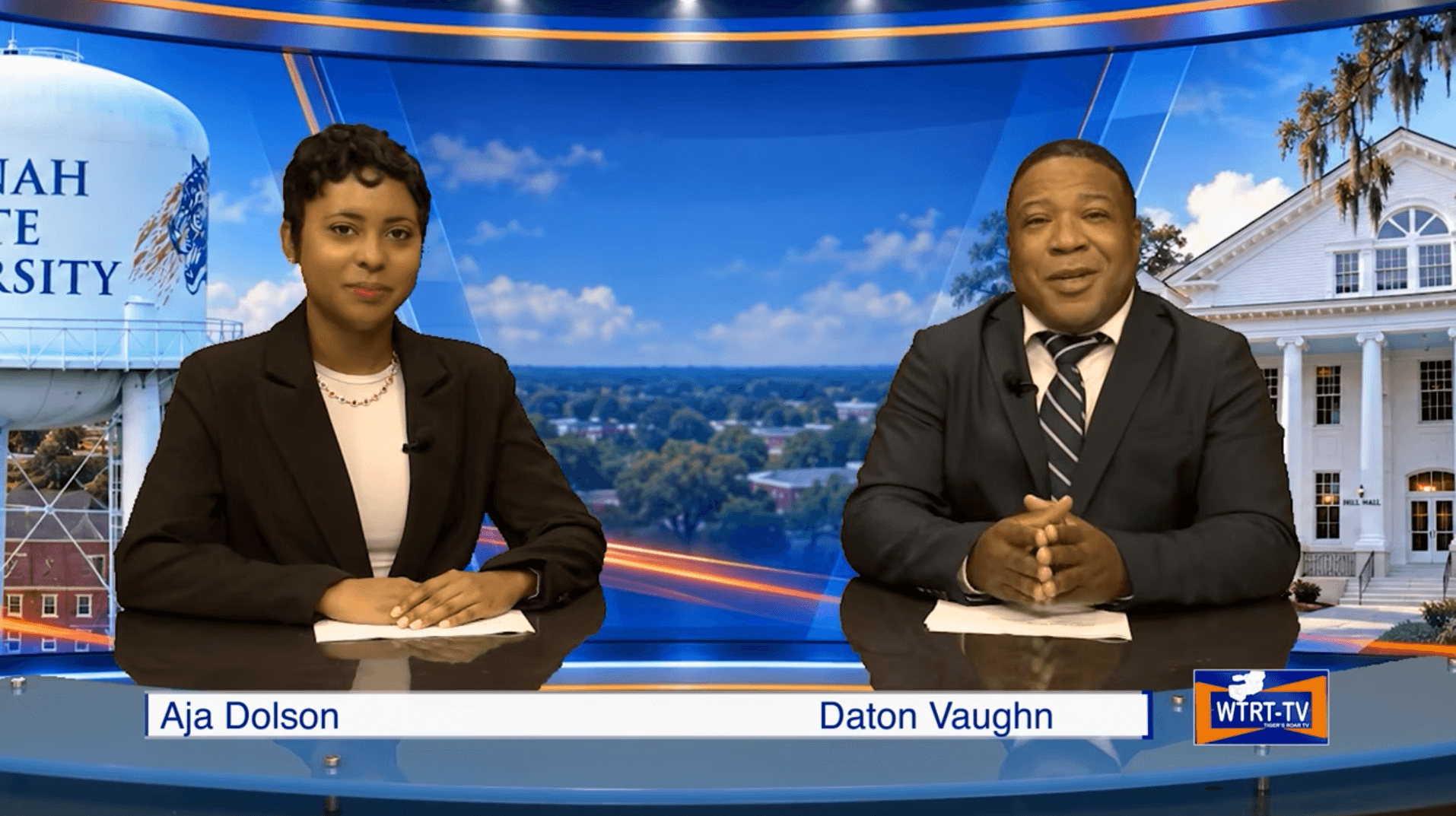
 SAVANNAH, Ga. — Savannah State University’s (SSU) College of Media, Arts and Communication (CMAC) and the City of Savannah today announced a landmark broadcast partnership: the student-produced Tiger’s Roar newscast is now air each week on Savannah Government Television (SGTV), the city’s government access channel carried on Comcast Channel 8.
Reported, written, anchored, shot and edited entirely by students in SSU’s Department of Journalism and Mass Communications, the weekly newscast will bring campus news and student success stories into cable households across Savannah, with replays and on-demand streaming available through SGTV’s online platforms. The agreement is a win for three audiences at once — the students, the university, and every resident of Savannah — and it directly advances two priorities of the University’s strategic plan, the #TheUproar2030: Priority 1, Student Success, and Priority 5, Community Engagement.
Just as important is what the agreement is designed to be: not a transactional content deal, but an industry-embedded learning partnership. Alongside the weekly broadcasts, the city will work directly with Savannah State students, teaching them how to communicate effectively with community and municipal audiences — an extension of the University’s classroom into City Hall.
Few credentials carry as much weight for a young journalist as an aired credit on a working television station — and now Savannah State students will earn theirs before they graduate. Every week, students will write for broadcast, produce packages, anchor, direct and crew a newscast that reaches a real audience, adding the kind of professional experience employers can see.
“Our students already produce professional-caliber newscasts in a fully equipped television studio every week,” said Dr. David Marshall, APR, dean of the College of Media, Arts and Communication. “What this partnership adds is the most powerful line a student can put on a résumé: their work aired on an actual television station. It’s one more way CMAC students graduate with experience employers can see.”
The Tiger’s Roar newsroom and its student-run television operation, WTRT Tiger’s Roar TV, are housed in a department whose journalism and mass communications program is nationally accredited by the Accrediting Council on Education in Journalism and Mass Communications — one of only three accredited programs in Georgia and the only HBCU in the state with that distinction.
The announcement also comes at a time of momentum. A $1.2 million Title III investment — secured for CMAC under President Whirl’s leadership — has upgraded the college’s television production studio, control room and podcasting facilities. While the students are already producing in industry-standard studios, the Channel 8 partnership gives the students access to a wider audience – the residents of Savannah.
For the University, the weekly broadcast creates a standing platform to showcase excellence on campus — student research, scholarships, commencement, athletics, the arts — so the wider community can see and celebrate what’s happening at Georgia’s oldest historically Black university, founded in 1890 and the oldest institution of higher learning in Savannah.
“Savannah State has trained exceptional storytellers for generations,” said Dr. Jermaine Whirl, president of Savannah State University. “Now, every week, our students’ work will appear in living rooms across the city they call home. This is what student success looks like — and Savannah gets to see it first.”
A Win for the City and its Residents
For the City of Savannah, the partnership deepens Channel 8’s public-service mission as a community hub: more locally produced programming for residents, a stronger bond between City Hall and Savannah State, and a front-row seat to the next generation of Savannah’s media workforce. The move also taps a national trend: as commercial newsrooms shrink, student journalists are increasingly filling local coverage gaps.
“SGTV is an important resource for keeping residents informed, engaged and connected to their community. Providing a platform for Savannah State University’s student-produced programming creates an opportunity to showcase emerging local talent while bringing additional perspectives and stories to our viewers. We value opportunities to connect with our educational institutions and support the next generation of communicators,” said Joe Shearouse, Chief of Information and Public Affairs for the City of Savannah.
Students will graduate with dual fluency — broadcast journalism and civic communication — opening career paths that run from newsrooms and production studios to public information, government communications and community affairs. For a college that already sends every graduate out with a professional résumé, portfolio and industry certifications, the city’s mentorship adds a dimension no classroom simulation could replicate.
Future plans for the partnership call for Savannah State student programming on Channel 8 to expand into arts and entertainment, tourism, sports and community affairs — and for the University’s storytellers to open the airwaves to communities across Savannah that have been underrepresented on television, giving their voices, neighborhoods and stories a regular place on the air, told with the craft of outstanding student journalism.
“I am very grateful and excited that our newscast can reach new viewers and a broader audience, said Aja Dolson, Mass Communications senior, student producer and lead news anchor. “Our student team works tirelessly to put the newscast together weekly and this opportunity feels like a way to showcase all of the hard work and talents of our team. I hope everyone enjoys what we produce and feels that they gain something from it.”
The significance is hard to overstate: one agreement gives students an aired professional credit and civic-communication training; gives Savannah State a weekly showcase of student success beamed into every corner of the city; gives underrepresented communities a voice on the air; and gives residents a stronger Channel 8 — dividends that will accrue to the University, its students and the city for years to come.
